Should Both Partners Get Tested for STDs Together?
This is a subtitle for your new post
Introduction
When two people are sexually active together, STI testing is often treated as an individual decision. However, there are situations where testing both partners can be especially helpful. This is particularly true when starting a new relationship, after unprotected sex, when one partner has symptoms, or when either person has recently been diagnosed with an STI.
Testing together does not mean that either partner has necessarily done anything wrong. It can simply provide both people with clearer information about their sexual health and make it easier to discuss prevention, treatment, and future testing.
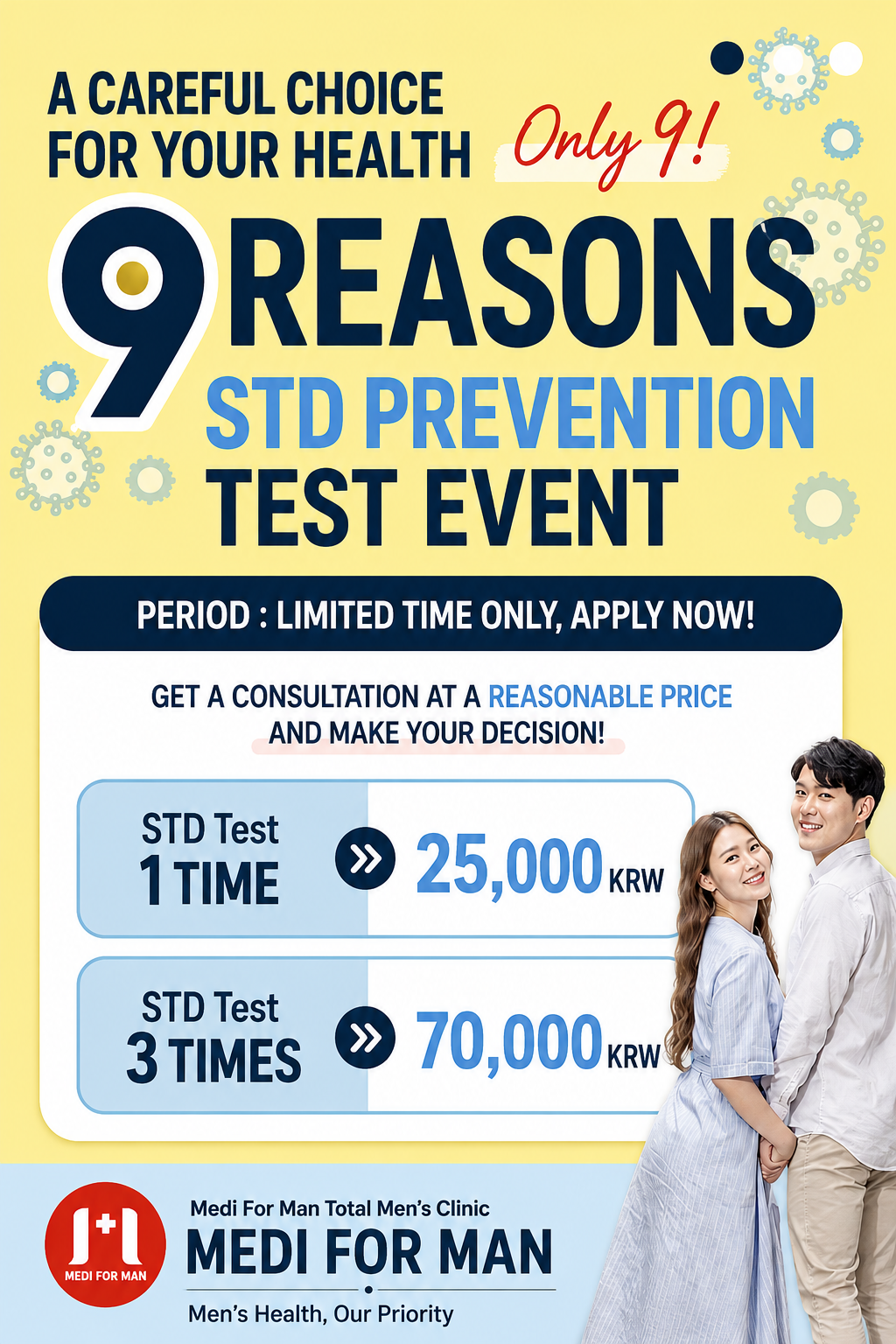
For couples living in Busan, international patients, expats, and visitors in South Korea, confidential STI screening can also be a practical way to address sexual health concerns together.
Why Should Both Partners Consider STD Testing?
One partner may have no symptoms
Many STIs can occur without noticeable symptoms.
A person can feel completely healthy while carrying an infection that may still be transmissible.
Testing both partners can therefore provide more information than relying on symptoms alone.
It can reduce uncertainty
When both partners know their current STI status, it may be easier to make informed decisions about:
- Condom use
- Sexual activity
- Future testing
- Partner communication
- Treatment
- Pregnancy planning
Testing can be particularly useful when neither person has recently been screened.
When Is Couple-Based STI Testing Especially Useful?
Before starting a new relationship
Some couples choose to test before becoming sexually intimate or before deciding whether to stop using condoms.
This can create an opportunity to discuss sexual health openly rather than making assumptions about a partner's status.
After unprotected sex
If a couple has had unprotected sex and either person's STI status is uncertain, both partners may consider medical evaluation.
The appropriate tests depend on the sexual exposure and previous testing history.
When one partner has symptoms
If one partner develops:
- Burning during urination
- Penile or vaginal discharge
- Genital sores
- Genital blisters
- Genital itching
- Pelvic pain
- Testicular pain
- Rectal symptoms
- Swollen groin lymph nodes
both partners may need medical advice depending on the suspected condition.
What STDs Can Couples Test For?
Chlamydia
Chlamydia is commonly included in STI screening.
Testing may involve urine or swab samples depending on the exposure site.
Because chlamydia can be asymptomatic, testing can be useful even when neither partner has symptoms.
Gonorrhea
Gonorrhea testing may be recommended after certain sexual exposures.
Possible testing methods include urine or site-specific swabs.
If oral or anal exposure occurred, tell the healthcare professional because testing may need to include the relevant site.
Syphilis
Syphilis is commonly evaluated through blood testing.
A person may not notice the early symptoms, so testing can be important when there has been a potential exposure.
HIV
HIV testing may be recommended depending on individual risk and sexual history.
Different HIV tests have different detection windows, so couples should follow professional advice regarding when testing should occur and whether repeat testing is appropriate.
Does Testing Both Partners Mean You Can Stop Using Condoms?
Not necessarily
A negative STI test does not automatically mean that condoms are no longer necessary.
The decision depends on factors such as:
- Which infections were tested
- When the tests were performed
- Whether either partner had recent exposures
- Whether the testing window was sufficient
- Whether both partners are mutually monogamous
- Whether pregnancy prevention is also needed
Some STIs can also be transmitted through skin-to-skin contact that condoms may not completely cover.
Couples should discuss their individual circumstances with a healthcare professional.
What If One Partner Tests Positive?
Both partners may need evaluation
If one partner receives a positive STI result, the other partner should not simply wait for symptoms.
Depending on the infection, recent sexual partners may need:
- Testing
- Preventive or presumptive treatment
- Follow-up testing
- Partner notification
- Temporary sexual precautions
The exact approach varies by infection.
Avoid reinfection
If an STI is diagnosed, continuing sexual contact before treatment is appropriately completed can sometimes result in reinfection.
Both partners should follow their healthcare professional's instructions about treatment and when sexual activity can safely resume.
Can Both Partners Get Tested on the Same Day?
Yes, in many situations
Couples can often arrange appointments around the same time, although each person will generally have an individual medical consultation.
The testing plan may differ between partners depending on:
- Sexual history
- Symptoms
- Previous diagnoses
- Type of sexual exposure
- Testing history
- Current medications
Testing together can make scheduling easier, but each person's medical assessment should remain individualized.
What Happens During a Couple's STI Screening?
Individual consultation
Even when partners attend together, healthcare professionals may ask each person about their own sexual health.
Questions can include:
- Date of recent sexual exposure
- Type of sexual activity
- Condom use
- Previous STI testing
- Previous STI diagnoses
- Current symptoms
- Recent partners
- Known STI exposure
Honest answers help determine which tests are appropriate.
Possible testing methods
Depending on the circumstances, testing may involve:
- Urine tests
- Blood tests
- Genital swabs
- Throat swabs
- Rectal swabs
- Swabs from genital sores or blisters
Not every person needs every type of test.
Should Couples Test for the Same STIs?
Not always
Although couples may have had the same sexual exposure, their testing requirements can differ.
For example, one partner may need a throat swab because of oral exposure, while another may require a different sample based on their sexual activity or symptoms.
A healthcare professional can create a testing plan based on each person's circumstances.
What If Both Partners Test Negative?
Understand what a negative result means
A negative result can be reassuring, but it should be interpreted according to:
- The infection tested
- The type of test used
- Time since exposure
- Testing site
- Recent sexual activity
If testing occurred too soon after an exposure, repeat testing may sometimes be recommended.
A negative result also does not necessarily rule out every possible STI if only a limited panel was performed.
What If One Partner Has No Symptoms but Tests Positive?
Treatment may still be important
An asymptomatic positive result is still clinically important.
The person should follow the healthcare professional's treatment recommendations and discuss partner management.
The other partner may also need testing or treatment depending on the infection.
There is no need to wait for symptoms before taking appropriate action.
Should Couples Get Tested Before Marriage?
Testing can be part of preventive care
Some couples choose STI screening before marriage or before becoming sexually active together.
This can be especially useful when:
- Either person has had previous partners.
- Previous STI testing is unknown.
- One partner has never had comprehensive screening.
- The couple wants greater confidence about their sexual health.
- Pregnancy is being planned.
STI screening can be discussed alongside other appropriate preconception health checks.
STD Testing for Couples in Busan
What should international couples consider?
Couples in Busan can look for a healthcare provider offering confidential STI screening and sexual health consultations.
International patients may want to confirm whether the provider offers:
- Chlamydia testing
- Gonorrhea testing
- HIV testing
- Syphilis testing
- Urine testing
- Blood testing
- Swab testing
- English-language assistance
- Confidential consultations
- Follow-up care
This can be particularly helpful for foreign visitors and couples who are unfamiliar with healthcare services in South Korea.
Can Couples Ask for a Full STD Panel?
Discuss what "full testing" means
The phrase "full STD panel" can mean different things at different clinics.
There is no universal test that detects every STI from one sample.
Depending on the circumstances, a healthcare professional may consider testing for:
- Chlamydia
- Gonorrhea
- Syphilis
- HIV
- Other infections when symptoms or exposure history indicate
Testing should be based on the person's actual exposure rather than simply ordering every available test.
How Can Couples Make STI Testing More Comfortable?
Have an open conversation
Sexual health discussions can sometimes feel uncomfortable, especially in a new relationship.
Couples can make the process easier by:
- Agreeing to test together.
- Avoiding blame.
- Discussing results privately and respectfully.
- Sharing accurate sexual health information.
- Following treatment recommendations.
- Agreeing on future testing and protection.
An STI diagnosis does not automatically indicate infidelity. Some infections can remain unnoticed for long periods, and determining when an infection was acquired may not always be possible.
Conclusion
Both partners getting tested can be a practical approach when starting a new relationship, after unprotected sex, when one partner has symptoms, or when either person has been diagnosed with an STI. Testing together can provide useful information and help couples make informed decisions about protection and sexual health.
However, both partners do not necessarily need identical tests. The appropriate testing plan depends on each person's sexual history, symptoms, exposure sites, previous testing, and timing. Tests may include urine, blood, or site-specific swabs.
For couples in Busan, including international patients, expats, and visitors, confidential STI screening can make it easier to address concerns together. If one partner receives a positive result, both people should seek appropriate medical advice rather than waiting for symptoms.
Frequently Asked Questions
Should both partners get tested for STDs?
In many situations, testing both partners can be useful, particularly before a new sexual relationship, after unprotected sex, or when one partner has an STI diagnosis. The specific tests should be based on each person's exposure and medical history.
Can couples get STD tests on the same day?
Often, yes. Both partners can arrange consultations around the same time, although each person should receive an individual assessment because their testing needs may differ.
Do both partners need the same STD tests?
Not necessarily. Different sexual exposures, symptoms, and testing histories can mean that one partner needs additional or different tests.
Should couples get tested before starting a new relationship?
Testing can be a sensible option, especially when partners want to understand their current STI status before becoming sexually active or changing their approach to protection.
What if one partner tests positive and the other is negative?
The partner with the positive result should follow treatment recommendations. The other partner may need follow-up testing or treatment depending on the specific infection and timing of exposure.
Can I have an STD without symptoms while my partner has symptoms?
Yes. STI symptoms can differ between people, and one partner may have noticeable symptoms while the other has none.
Does a negative STD test mean couples can stop using condoms?
Not automatically. The meaning of a negative result depends on the infections tested, timing, recent exposures, and the couple's circumstances. Condoms may also be important for pregnancy prevention and reducing other STI risks.
Where can couples get STD testing in Busan?
Couples can seek a healthcare provider in Busan that offers confidential STI screening. International patients may want to confirm available tests, English-language support, confidentiality, and follow-up services before booking an appointment.